
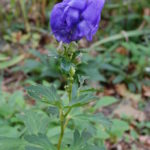
 Aconitum (Aconitum napellus) Monkshood, Wolfsbane, no matter what you call it, all parts of this plant are poisonous and should be handled while wearing gloves. It is a perennial hardy through zone 4. It can stand sun but prefers partial shade. A great accent for the back of your shady border, it grows to a height of 3’ to 5’.
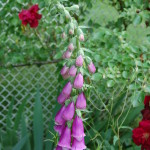 Foxglove (Digitalis spp) Foxgloves are another plant that should only be handled while wearing gloves. They contain digitalin from which digitalis is made. Too much of it can cause a heart attack. Biennial and hardy through zone 4, foxgloves are shade lovers. Their spectacular flower stalks grow to 2’ to 5’ high depending on the variety.
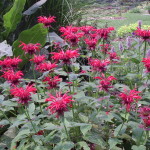
Bee Balm (Monarda spp.) Bee balm is a useful herb thatattracts bees, makes a refreshing herbal tea and smells lovely in your garden. That lovely scent keeps the deer away. It is a native perennial plant that is hardy through zone 4. Depending on the variety, it grows 2’ to 4’ tall. Bee balm is a sun lover but will tolerate a little shade.
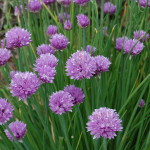
Chives (Allium schoenoprasum) Members of the allium family are almost guaranteed to be off the menu for deer. Sun loving chives are perennials that are hardy through zone 3. They have lovely lavender flowers that appear in the spring. Chives grow in bunches that spread annually and grow to 10” to 16” tall.
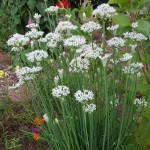 Garlic Chives (Allium tuberosum) A cousin of chives, garlic chives have an onion flavor with a strong hint of garlic. Both are flavors that deer stay away from. The white flowers of garlic chives burst onto the scene in August. It is hardy through zone 3 and grows 18” to 24” tall.
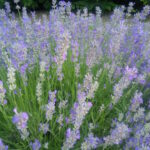 Lavender (Lavandula spp) Lavender is beloved by bakers, crafters, perfumers and bees. Deer dislike it for all the same reasons. Lavender will gladly grow in any hot, dry, sunny spot in your yard. The hardy lavandula varieties (English lavender) will easily overwinter through zone 5. They grow between 18” and 30” tall.
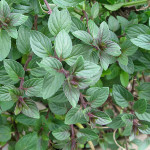
Mint ( Mentha spp) A huge family of plants native to every continent except South America and Antarctica. They are characterized by their square stems and aggressive growth. Most are perennial through zone 4. And deer do not eat any of them.
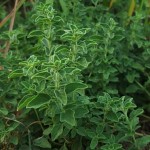 Oregano (Origanum vulgare) A widely used culinary herb that deer will not eat, oregano is a perennial growing 1 to 2 feet tall and hardy through zone 5. It needs full sun and dry conditions.
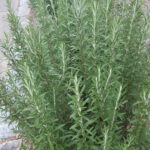 Rosemary (Rosmarinus officinalis) Rosemary is another drought loving Mediterranean herbs with a strong scent. Deer dislike its strong, piney scent. Rosemary is a culinary herb frequently used to flavor meats. It is only reliably hardy through zone 7. It will grow nicely in a hot, sunny dry spot like lavender eventually reaching 5’ in height.
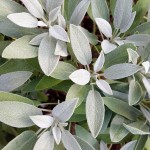 Sage (Salvia officinalis) Sage is both strongly scented and has fuzzy leaves, both characteristics that deer dislike. Sage is a perennial that is hardy through zone 5 and depending on the variety will reach a height of 3’. Grow it in a sunny location and don’t overwater it.
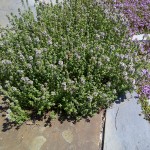 Thyme (Thymus vulgaris) Another strongly scented herb that deer stay away from. A small, shrubby perennial, thyme is hardy through zone 5. Mature plants range in size from 6 to 12 inches, depending on the variety. Thyme prefers a sunny location, but it can tolerate a little shade. It is drought tolerant.
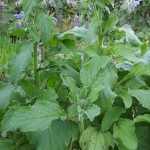
Borage (Borago officinalis) Borage is edible but most people, like deer, don’t care for its fuzzy leaves. It is an annual that will freely self-sow itself in your garden. It produces bright blue flowers on 18” to 24” plants in full sun.
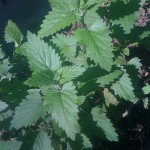
Catnip (Nepeta cataria) Catnip’s serrated leaves and square stems giveaway its membership in the mint family. The fuzz covering its leaves keeps the deer away. Catnip is a perennial that is hardy to zone 3 and grows to a height of 3 feet. Like most mints, it prefers full sun but will tolerate some shade.
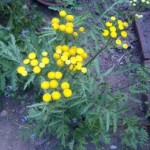
Tansy (Tanacetum vulgare). Tansy has neither a strong scent nor fuzzy leaves, but deer seem to dislike its ferny leaves. It is a perennial and hardy through zone 4. Mature plants reach 3 to 4 feet in height. It does best in full sun but will tolerate a little shade. It is also drought tolerant.
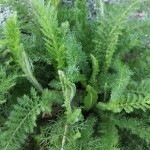 Yarrow (Achillea millefolium) Yarrow is another herb, like tansy, that has neither a strong scent nor fuzzy leaves. Instead, it has ferny leaves that deer stay away from. A perennial that is hardy through zone 3, it will grow to 2 to 4 feet depending on the variety. It wants full sun and is drought tolerant.
33 Responses
Do deer eat the herb Chervil?
Herbs are deer resistant because of their strong flavors. Deer won’t eat them unless there is nothing else to eat.
We have lots of deer & all of these are in our herb garden. I am working on a post for deer resistant plants. I just found Vinta for a pretty flower plant.
I have a love/hate relationship with the deer. I feel sorry for them when the snow is deep ( so I feed them), and then hate them come summer when they’re nibbling away at everything. My recent solution has been to start landscaping with herbs and other plant material they don’t like and occasionally tuck something they normally eat into a ‘screen’ of these plants. Seems to be working!
Caroline
And herbs are beaautiful too! So many of them have pretty flowers while others have wonderful foliage. Such beautiful deer repellent.
I would like to plant a whole bunch of different herbs in a container. (large) You did not mention Basil in the deer resistant plants and that would be one of them. Which ones could I plant in a big container? Thanks I live in a rental place and would love to have a garden but this is it.
I grew a big pot of basil this summer here in the SF Bay Area, and kept it up on my deck, away from the deer… but they eventually found it anyway and stripped it to the stalk. Given my experience, I wouldn’t consider basil to be remotely deer-proof…
Deer have differenct diets in different areas so plants that local deer may not touch in my garden are considered tasty by other herds of deer in other towns. Also, if there is not enough food around, deer will eat anything out of desperation just as starving humans do.
I have quite a large deck ground level. I purchased some cheap netting and fastened it onto the posts around the deck. Last year I planted some smelly plants at one point and they never came close. The year before that? They knew when I was out and came around the open part on the front and ate all my container’s of flowers. I too have a love hate relationship with them. They are very smart animals.
My daughter thought she would have to build a very high fence and couldn’t do it alone. I told her that fence only needed to be high enough that the deer could not see over it – about 4 to 5 feet at the most. But it needs to be solid so they cannot see through it. If they cannot see over or through it they will not jump as they can’t see where they will land. She did the fence about 6 years ago and has had no deer in her back yard since. She has lovely flowers there. The front yard is another problem. She is restricted to deer proof flora as she cannot build a fence in the front due to restrictions in the neighborhood.
She is fortunate that her fence has kept the deer out of her backyard. Deer can jump 8 feet high so most deer fences are at least that tall.
If it is a small enclosure, they won’t jump a low fence. I have one of these in my back yard, and the deer don’t go near it at all:
https://www.gardendefender.com/
I’ve got a batch of Earthboxes in it, and since space is limited, thanks to your advice, I think I will plan on planting most of my herbs in a planter OUTSIDE the enclosure. The basil will get planted on the inside though!
I would like to put in stakes around my garden and wrap fishing line around all of them about 5 or so inches apart up to about five feet or so. I heard the deer have poor eyesight and can’t see where the top of the fence is to jump it. Is this true?
Sorry, not true. And deer can jump up to 8 feet high so your deer fence will need to be higher.
Do deer eat Roman Chamomile? I would like to do a chamomile lawn/ground cover area but do not want to attract deer by providing them a feast area.
Roman chamomile is considered deer resistant meaning that deer won’t eat it unless there is nothing else to eat. Aromatic herbs are deer resistant because deer don’t like strongly scented or strongly flavored plants.
Will Hops (cascade) deter deer?
I planted hops in a few areas of a fence a few years ago in locations that deer have been observed jumping over the fence . One of the location is clearly visible from our family room I have watched young deer come near the hops plants, not eat and no deer jump the fence in that area.
Deer do not care for strongly scented or strongly flavored plants. Hops, which has both, is a good deer deterent.
do deer eat ginger root
Deer do not eat the root of the ginger plant because they do not dig for their food. They eat what is readily available above the ground. The flowers and foliage of ginger are deer resistant but bear in mind that when there is very little food available, deer will eat anything.
Preach it, Herb Lady! When they are hungry they will eat anything.
Coyote or Bob cat urine is good to spray around your garden. Any predator urine.
Just don’t spray too close to your house. It stinks!
I have found that taking the ‘juice’ from a jar of jalapenos, thinning it down with water, and spraying it on my pansies and petunias keep the deer at bay. I need to do it every two weeks, however, during the rainy season. I use the pansies in salads and have not noticed them being spicier from the pepper spray. The bunnies will avoid them as well, and stick to the dandeliions around my land. Many of the deer repellent sprays cannot be used around food crops, so I have taken to making my own pepper spray!
Great solution! Thanks for sharing.
I couldn’t figure out the horrible smell wafting throughout my garden. I kept checking my shoes, looking for dead animals, feces, etc. I asked my neighbor if he smelled it. “Oh, I just sprayed my front yard with coyote urine to deter the deer.” Inside I go. It reeks.
I have found very few door proof plants. Ricinus, Helleborus, Arum italicum etc. may be deadly, but they will bite them in half just to check. Salvia, Mentha, Monarda, Nepeta, Perovskia – all of the fragrant plants do get eaten. Fawns especially will try them. They even ate Orchids off the table on the porch. I think I will grow rocks as those seem to multiply well in my yard.
Re the deer eating the basil. think this (deer going after ‘deer resistant’ plants happens at the end of the summer in the West, when deer are desperate for water. I know my ‘deer resistant’ Owari Orange got violently pruned in early October, just before the rain started. That has happened to me before, too. Just before the rains, the deer will strike: they need moisture, and you’re the only game in town.
That’s exactly what “deer resistant” means. That deer will not eat a plant unless there is nothing else to eat or, in your case, when they need water and there is nothing else available.
I’m loving the fact that herbs are, for the most part, deer resistant. I love using fresh herbs in cooking and baking. I also love Daffodils and Hellebores so I’m going to plant lots of them. I had deer munch on the young Hellebore shoots but they avoided the leathery, serrated, older leaves. I also didn’t see any munching on my Epimedium. Not sure if that was because deer don’t like it or because they were planted amongst the Hellebores.