
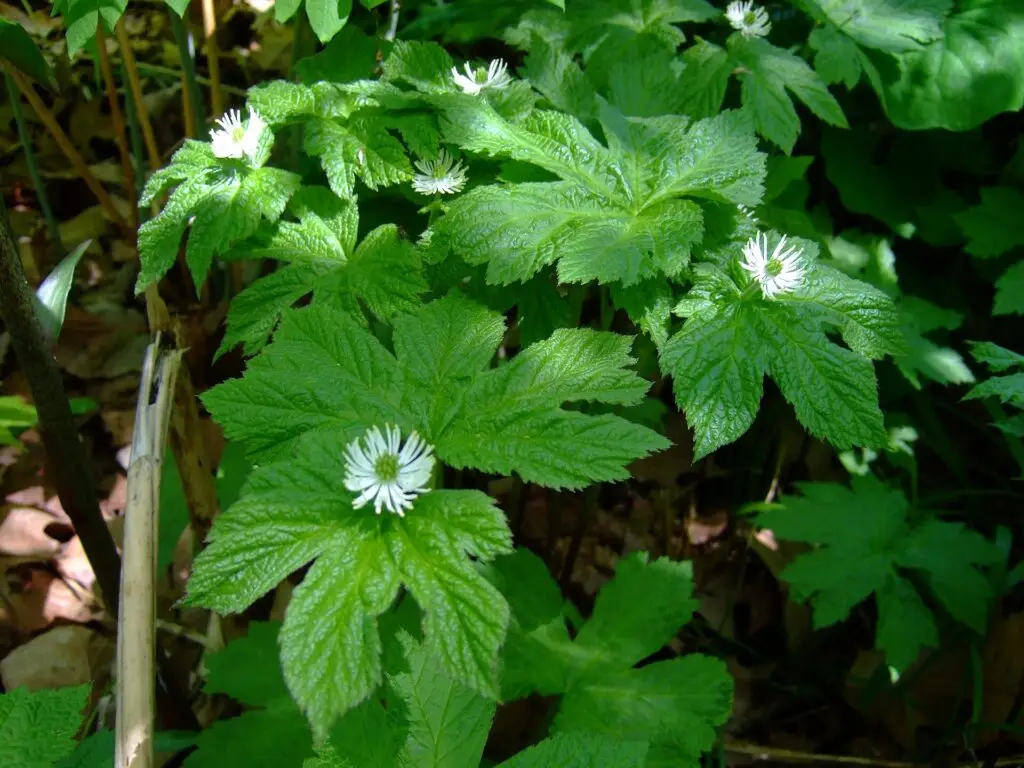
Goldenseal (Hydrastis canadensis) is a woodland perennial that is hardy in zones 5 – 8 and native to Northeast North America. It is a member of the buttercup family. Its roots have been used for centuries by the native peoples who pass on their knowledge to European colonists. It became so popular that it was over-harvested and is now endangered.
Cherokee tribes used goldenseal roots as an antiseptic, a general health tonic, and to treat snakebite. The Iroquois tribes used the roots to treat whooping cough, pneumonia, and digestive disorders. Early American colonists used the roots primarily as an eyewash and to treat sore throats, mouth sores, and digestive disorders.
Goldenseal is one of the most popular herbs sold today. It is used for the treatment of nasal congestion, mouth sores, eye and ear infections, and as a topical antiseptic. It is commonly believed to help boost the immune system and increase the efficacy of other medicinal herbs.
Goldenseal grows extremely slowly. The seeds can take up to three years to germinate. Once they germinate, they go through three life stages: seedling, juvenile, and reproductive. The plants remain in the seedling stage for up to two years. During this time, they have only their cotyledons. After the first two or three years, the plants develop their true leaves and the root system starts to develop.
During the fourth through sixth years, the plants reach reproductive maturity, developing a forked stem, sic to eight inches tall, and two leaves. When the plants emerge in the spring, a single, small white flowers appears between the two leaves which is pollinated by small bees and syrphid flies. Goldenseal can reproduce via seeds, but it most often increases by its roots underground. The roots spread and develop new plants.
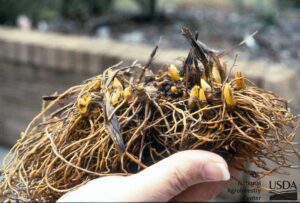
Goldenseal is harvested after it reaches reproductive maturity, during its fourth through sixth years. It is harvested in the fall after the tops of the plants have died back. Use a garden fork to carefully dig up the roots, keeping the large ones intact. Wash them with running water but do not soak them which will result in the roots rotting rather than drying.
Dry the roots on a screen. They will lose 70% of their weight when fully dried. A good test of whether the roots are completely dried is to break a large root. It should snap cleanly but not be brittle.
If you want to grow goldenseal, you will either have to plant it in a woodland garden or an actual woodland, with 60% to 80% shade, or provide artificial shade using a structure covered with shade cloth or vines. When choosing a woodland site, look for a spot where mayapple, trillium, bloodroot, or black cohosh are already growing. They have the same shade requirements. Too much sun will result in plants with stunted growth and yellow leaves.
Goldenseal grows best in rich, moist loamy soil with good water drainage. In a woodland setting, planting on a slope will provide good drainage. Plant under hardwood trees which will shed their leaves every year providing the leaf litter that the roots need.
Propagating goldenseal is usually done by root cuttings. It takes four to six years for the cuttings to reach harvestable size. Cuttings should be taken in the fall. Plant them 2 to 3 inches deep and 6 to 8 inches apart. Keep moist them until your first frost.
Goldenseal can also be grown from seed. It is best to use fresh seed that is planted in the fall. Be patient. It can take 2 to 3 years for your seeds to germinate and then a further 5 to 7 years for the plants to grow to reproductive maturity.