
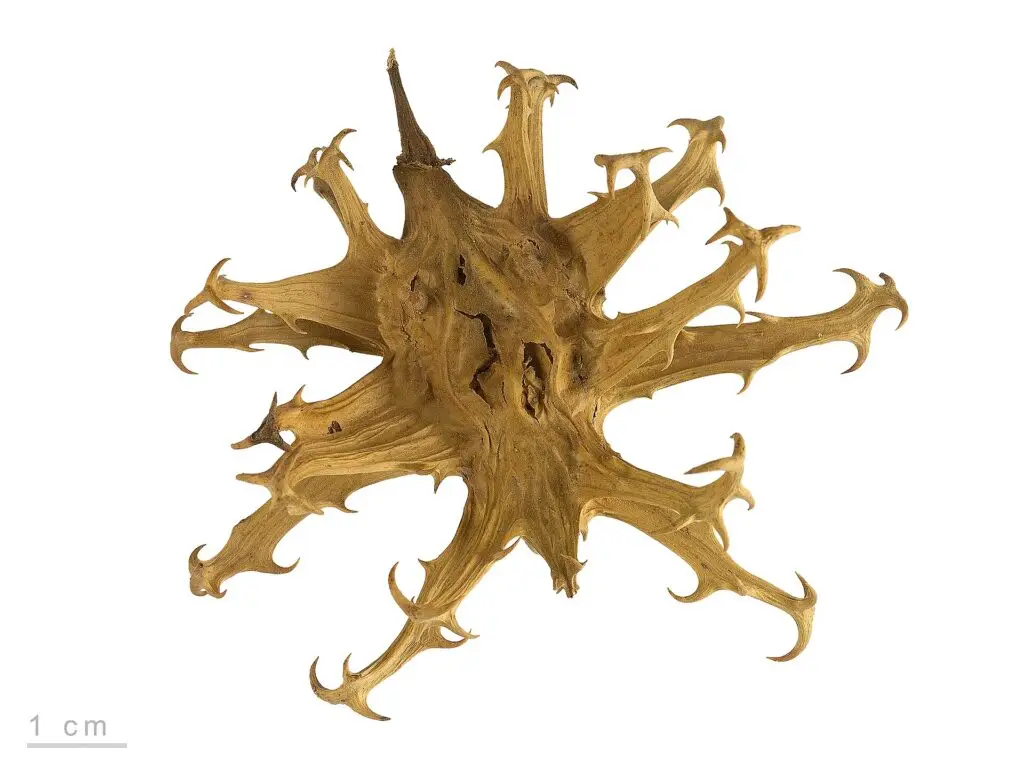
Devil’s claw (Harpagophytum spp.) is a perennial medicinal herb that is native to South Africa. It is now found in South Africa, Namibia, Southern Botswana, Southern Angola and the Kalahari Region. Other names for this plant are grapple plant and wood spider. It gets its name, devil’s claw, from the shape of its hooked fruit.
The plants’ tuberous roots are cut into pieces, dried in the sun, ground up and have been used by African native people for millennia to relieve pain. It is also used for stomach upsets, fevers, blood diseases, and as an anti- inflammatory. It is given to women to relieve postpartum pain. Ointments made with devil’s claw are applied to sprains, sores, ulcers, and boils.
Devil’s claw is a member of the sesame family. It is a perennial, hardy in zones 9 – 11. Not surprisingly, it prefers dry growing areas. It does best in light, sandy rocky soils. The plants are often found growing along roadsides and in waste grounds. Devil’s claw should be grown in full sun but will tolerate partial shade.
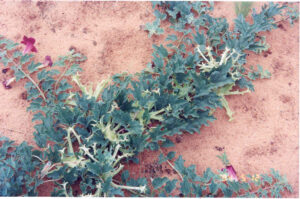
Devil’s claw is a prostrate, mat forming plant. The stems, which grow up to six feet in length are annual, dying back to the root in the fall. The leaves are grayish green and heart-shaped. The leaves, as well as the flowers, are only present during the rainy season from November to April which is summer in the southern hemisphere. The tubular flowers are dark violet with a yellow and white throat.
The fruit is woody with numerous long arms that have sharp, hooked thorns, as well as two straight thorns on the upper surface. The fruit looks like a giant claw.
Devil’s claw is grown for its thick, tuberous root. There is a large main root and surrounding secondary roots. It is the secondary roots that are harvested and dried for medicinal use. The primary root is left in the soil to grow new secondary roots. If you harvest the main root, it will kill the plant.
Devil’s claw is propagated in two ways. The first way is the easiest, just plant some of the harvested secondary roots and new plants will grow from them. Plant the tubers four inches deep and 20 inches apart. Be patient, it will take about four years for the new secondary tubers to be large enough to harvest.
More difficult is growing from seed. The seeds have a tough coating so soak them overnight in warm water to soften that coating. You can also carefully nick the seeds being careful not to damage the embryo inside. Plant the seeds shallowly. They need some sun to germinate. Indoors, keep the soil moist using a mister. Use a heat mat to keep the soil at a temperature of 75°F or warmer. Germination should occur in 2 to 3 weeks. You can plant the resulting seedlings outdoors, 20 inches apart, when the soil has warmed to 75°F.
You can also direct sow the seed in your garden once the soil has warmed to 75°F in the spring. Gently water your seeds just enough to keep the soil moist. After germination, thin the seedlings to 20 inches apart to allow for the plants to sprawl.
Plants grown from seed will take about four years before they are ready for harvest. To harvest, carefully dig up the tubers, separate the smaller, secondary tubers for harvest, and replant the large main tuber to grow more tubers for next year.
Slice the harvested secondary tubers into pieces and dry for use.