
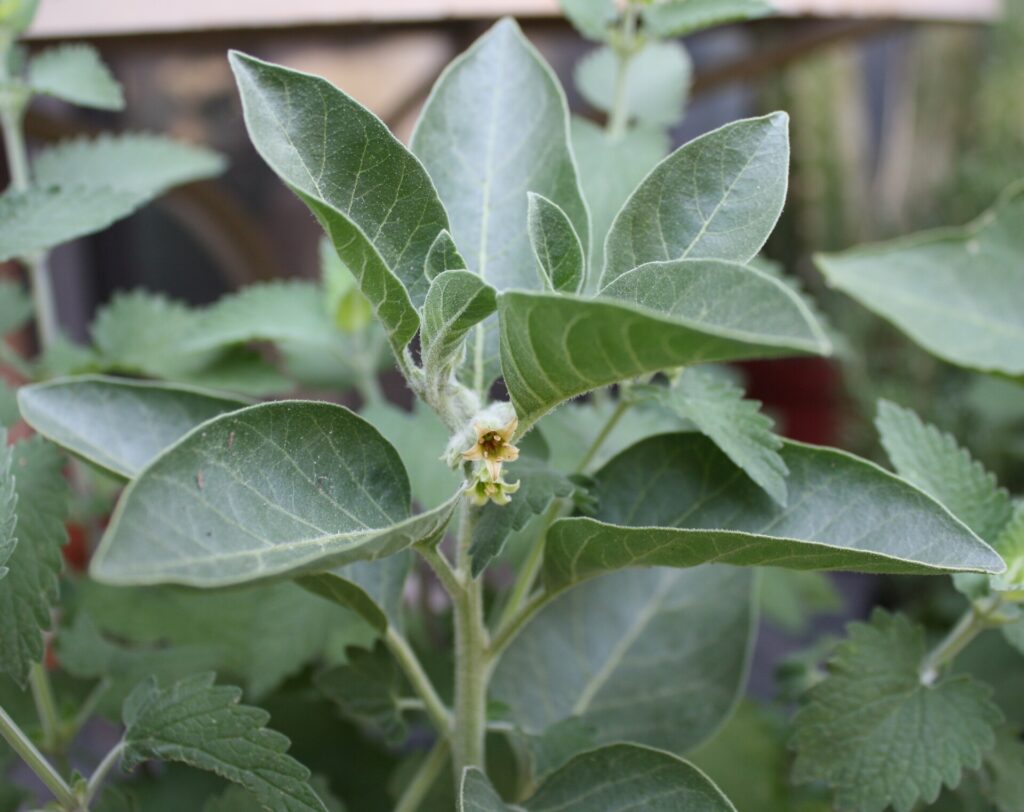
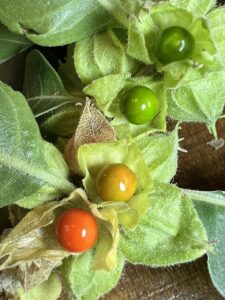
Ashwagandha (Withania somnifera) is a small shrub native to the Middle East, North Africa and Southeast Asia. It is also known as Indian Ginseng or Winter Cherry thanks to its red fruit. It is a member of the solanacea family which also includes eggplants, peppers and potatoes.
Ashwagandha is used in Ayurvedic medicine as an adaptogen and nerve tonic. The root, which smells similar to tomatoes, is harvested in the fall, dried and ground up. It is then added to honey, ghee (clarified butter) or water. It can also be brewed in a tea.
The plants are hardy in zones 9 – 12. North of those zones, it is grown as an annual. Ashwagandha prefers dry, well-drained soil and full sun, but will also grow in partial shade. Once established, it is drought tolerant. Only water it when the soil has become dry. Too much water will cause root rot and kill your plant.
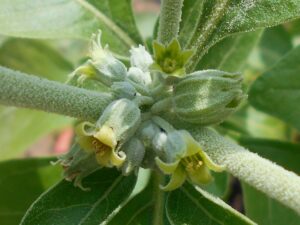
The shrubs grow 2 to 4 feet tall. The leaves are oval and 4 to 5 inches long. They are a grayish green with fine hairs on the undersides giving them a fuzzy feel. They have a distinctive odor of horse sweat. The flowers grow at the leaf nodes. They are small, green, and bell-shaped. Bloom time is midsummer. They develop into bright red cherry-sized fruit which contain the seeds. The seeds are similar in size and shape to tomatillo seeds.
Harvesting the roots is easy. In the fall when the leaves and fruit are dead or dying, use a trowel to gently loosen the soil around the shrub. Then grab the plant and pull the root out of the ground. Cut off the stems and foliage and wash the root. Immediately cut up the root into pieces. It is easier to cut up before it dries out. Dry the root pieces on a screen. Once dried, you can store them in a glass jar. I like Mason jars because you can get a good seal on the tops.
Propagating ashwagandha can be done in two ways. You can root softwood cuttings. Softwood cuttings are taken in the spring while the branches are still soft and pliable. Woody plants are notoriously difficult to root, so keep trying. Don’t give up!
You can also grow ashwagandha from seed. You can use the seed from the fruit. Start your seeds indoors 6 to 8 weeks before your last frost. Lightly cover the seeds. They need light to germinate. The seeds also need warm soil to germinate, 70°F to 85°F. Use a heat mat to keep your soil warm. Keep the soil moist using a mister so that your seeds don’t wash away. Watering with warm water is recommended. Your seeds should germinate in 1 to 3 weeks.
You can plant your seedlings outside in your garden when they are 4-inches tall and the outdoor temperatures are consistently 70°F or warmer. Space them 2 feet apart.