
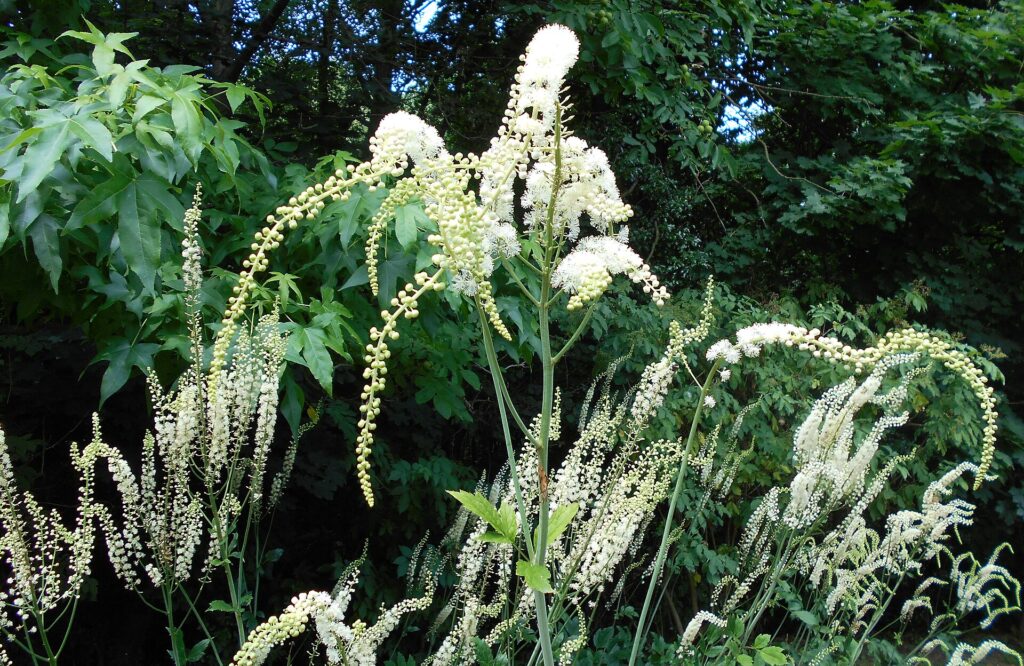
Black cohosh (Actaea racemosa) is a native perennial that is found from as far south as Georgia to as far north as Ontario Canada. It is in the buttercup family. Other names for it include bugbane, black snakeroot and fairy candle, a reference to its flowers which resemble candles.
Native Americans used the root to treat gynecological disorders. European settlers in the 19th century used the root to treat snakebite, inflamed lungs and pain from childbirth. Modern day uses include treating menopausal symptoms such as hot flashes. Use of black cohosh is not licensed in the US for medicinal purposes. It is licensed for medicinal purposes in Europe.
Black cohosh is the host plant for several azure butterflies, including the Appalachian Azure, the Holly Azure, and the Spring Azure. The pollen and fetid smell of its flowers attract beetles, flies, gnats and bumblebees. The foul smell makes them both deer and rabbit resistant.
Black cohosh is hardy in zones 3 – 8. These are forest plants that grow best in shade or part shade. When grown in the sun, the leaves are lighter in color and can be burned by the sun. The plants prefer rich, acidic soil. Their preference for moist soil makes them candidates for the edges of rain gardens. When grown in your garden, you will need to stake the tall blossoms. Be sure to keep the soil moist.
The leaves grow directly from the rhizome in a clump that is about 3 feet tall and 2 – 4 feet wide. The leaves are dark green, serrated and compound. The white flowers grow on racemes up to 6 feet tall, shorter if they are grown in the sun. The racemes can be straight or gracefully arched. Bloomtime is mid- to late-summer. The spent flowers form attractive seedpods that can be left on the plants for winter interest. Each seedpod contains up to three seeds.
Propagation is by division or seed. The clumps grow slowly. They do not need to be divided for the health of the plant. If you wish to divide your clump, wait until it is at least three years old. Dig up your plant and cut the clump in either the spring or the fall. I prefer dividing my perennials in the fall so that they have a chance to settle in and grow their roots before the winter. Dividing black cohosh is difficult because the roots are tough.
These plants are easy to grow from seed. You can sow your seeds in either the spring or the fall. If you want to sow your seeds in the fall, plant them directly in your garden. They need a 3-month period of cold stratification.
If you are sowing indoors, in the spring, you can cold stratify your seeds in your refrigerator.
Sow your seeds ¼-inch deep in a container of moistened soil, cover it with a plastic bag and put it in your refrigerator for three months. Check the container periodically to make sure that the soil is still wet. If it begins to dry out, you can mist it to moisten it again.
If you start your seeds indoors, you can plant the resulting seedlings out in your garden after your last frost. Space them 2 feet apart. The plants reach maturity and begin to bloom in 3 – 5 years.