
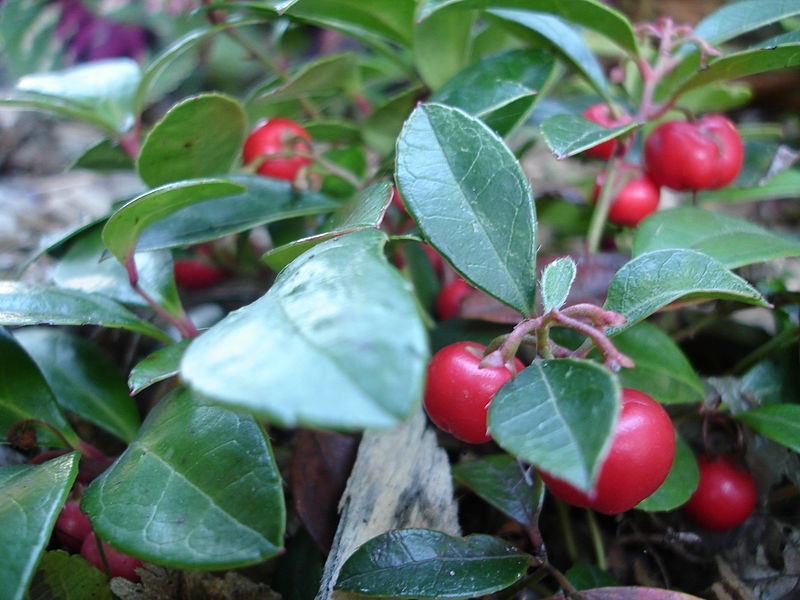
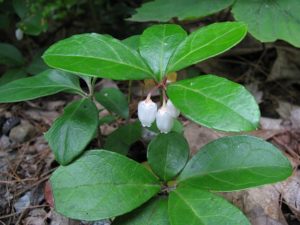
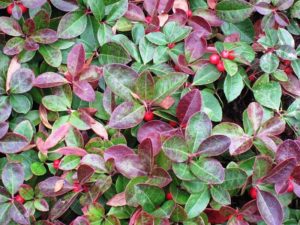
The plants are evergreen, retaining their leaves during the winter. The leaves turn red in the colder weather. The flowers are white or pale pink and shaped like bells. Bloom time is July and August. The berries follow, ripening to red in late fall. The berries are edible by both humans and animals. They are an important food source during the winter for birds, deer and rodents such as squirrels, mice and chipmunks. Left on the plants, the berries last all winter, becoming desiccated by late winter.
Wintergreen is usually sold as plants. Do not dig them up from the wild. They are an endangered plant. Only use nursery stock. Plant them 12 to 16 inches apart. They will look sparse at first, but will gradually fill in.
Wintergreen is easy to propagate. As the stems creep across the ground, they develop roots along their length. You can simply snip off a piece of a stem that has roots, carefully dig up the root ball, including the soil it is growing in, and replant elsewhere. You can also take cuttings in the spring when the plants are actively growing. Dip your cutting in rooting hormone and plant it in a container. You will know that roots are growing when you see new leaves on your cutting. Plants without roots cannot grow new leaves.
Wintergreen can also be grown from seed. The seeds need to be cold stratified first. Cold stratification mimics the cold weather of winter which some plant seeds need to germinate. 12 weeks before your last frost, wrap your seeds in a damp paper towel or damp peat moss and place in a plastic bag. Put the plastic bag in your refrigerator for 4 weeks. Then remove it from your refrigerator and sow the treated seeds in a container 1/8 inch deep. Be patient. The seeds will be slow to germinate. It could take up to 2 to 3 months. You can plant your seedlings outdoors after your last frost when they have two sets of true leaves. Space them 12 to 16 inches apart.
4 Responses
what do the wintergreen sprouts look like when they emerge
They look like this: https://commons.wikimedia.org/wiki/File:Eastern_Teaberry_Foliage.jpg
I have a wintergreen groundcover that was given to me as a gift. I was told I could put this in the ground, I am in North Carolina. It is in the pot that it was purchased in right now. I have a shady spot that I think it would grow but my question is, would I be better off to put it in a pot in my garden rather than in the ground and should I wait until the fall so it is cooler than 90 degrees?
Thanks
I recommend getting it into the ground as soon as possible. Groundcovers are stressed when grown in pots and not allowed to sprawl. They need to be in the ground. Think of it as trying to wear shoes that are too small. You are correct that this is not the ideal time to be transplanting plants, but since this one needs to get into the ground ASAP, plant it now and then water it often enough to keep the soil moist. That will help it get settled and relieve the stress from the heat.