
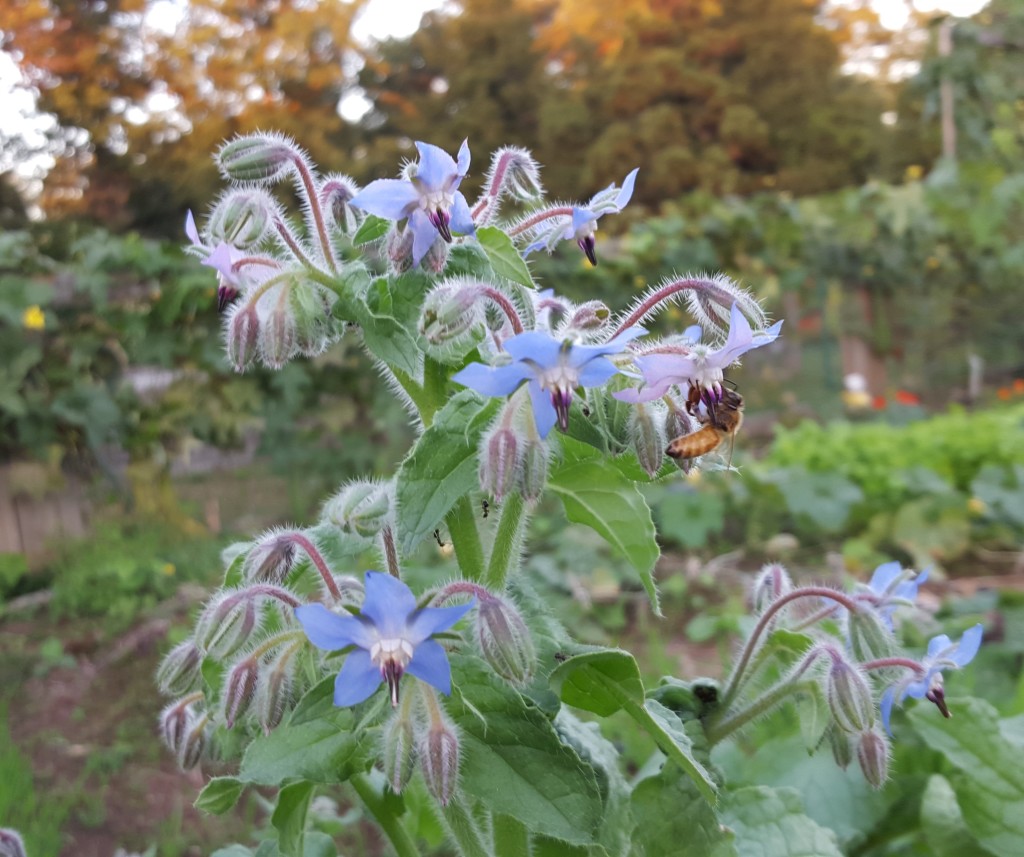

I am often asked what to do with borage (Borago officinalis). What is it good for? That’s a good question because you won’t find it in any recipe ingredients list nor will you find recommendations for usage for common ailments. So why would you want to grow it?
Borage is one of my favorite herbs because it is so useful. Both the flowers and the leaves are edible. The flowers taste like honey but they are such a pretty blue color that they also make attractive decorations. The leaves taste like cucumbers. Harvest only the young leaves. The older, larger leaves are covered with stiff hairs that are not pleasant to chew. The younger, smaller leaves have softer hairs that are easier to eat. Plus you use them raw in salads so the textures of the salad ingredients help to mask the hairs. Warning: borage is reputed to have a mild laxative effect, so be careful how much you consume in one sitting!
Borage’s most important use is in your vegetable garden where it attracts beneficial insects. The flowers are bee magnets. The plant also repels pests. I have used it successfully in my garden to repel both the cucumber beetle and the tomato hornworm. The first time that I grew it with tomatoes, I didn’t deadhead it. It went to seed, died, and suddenly I was finding tomato hornworms. I am more diligent now to keep my borage deadheaded and growing all season to deter tomato hornworms and cucumber beetles. All it takes is one borage plant next to my cucumber tepee and I don’t see a single cucumber beetle on any of my vines. Since cucumber beetles eat all cucurbits, not just cucumbers, I always plant a few borage in my pumpkin and melon patches.

Although I have not tried it myself, borage is reputed to be a companion plant to strawberries. Home gardeners swear that it improves the flavor of their strawberries. Bees love it so pollination is better when borage is planted with strawberries. Most importantly, its flowers attract beneficial insects like praying mantis and predatory wasps who feast on insect pests that damage strawberry plants.
Borage is grown commercially for its seed oil which is full of GLA (gamma- linolenic acid). GLA is full of healthful fatty acids. Borage seeds have the highest amount of GLA of any plant.
Borage is a tall annual that is native to Southern Europe and the Mediterranean. It has naturalized throughout Europe and then North America after its introduction by European colonists. The plants grow best in full sun but will tolerate a little shade. In full sun, they will grow to 2 to 3 feet tall and up to 24 inches wide. You might want to stake your plants to keep them from falling over. They are not fussy about soil or water.
The leaves are large, 2 to 5 inches long, gray green and covered with stiff hairs making them deer resistant. The flowers are star shaped and bright blue. Immature flowers are pink until they are fully open. Less commonly seen is a cultivar that has white flowers. Bloom time is late spring through summer. Keep your plants deadheaded so that they don’t go to seed until your crops are harvested.

Borage is a prolific self-sower to the point of invasiveness. I always warn people to not let it go to seed or they will find hundreds of seedlings the following spring. The upside is that you then have lots of seedlings to share with gardening friends!
Not surprisingly, it is easy to grow from seed. Sow the seed indoors 3 to 4 weeks before your last frost. Plant them ½ inch deep and keep them moist. Optimum soil temperature is 70⁰F. Germination should occur within 5 to 15 days. Transplant your seedlings outdoors when the soil has warmed and all danger of frost has passed.
You can also direct sow your seed in your garden after your last frost when the soil has warmed. These plants will grow and bloom later than ones you start indoors. It’s a good idea to both start seeds indoors and outdoors to ensure that you will have plants growing and blooming throughout the growing season.